Adhesives for active lens alignment
Dual UV and heat cure adhesives with low shrinkage hold the lens in position after active alignment, ensuring camera modules achieve uniform sharpness across the entire frame.
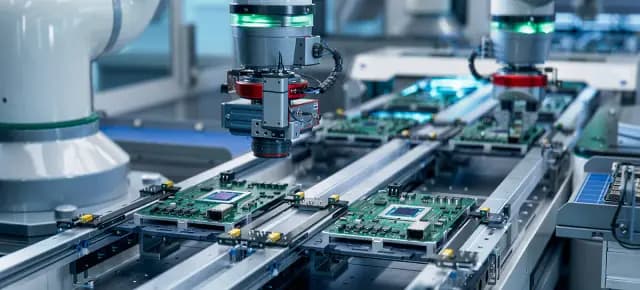
Active alignment is a technology in which the lens is moved along six axes while the image sensor is capturing images until optimal focus is achieved. That position must then be fixed instantly. The adhesive is the component that determines the final accuracy.
This technology is becoming increasingly common as smartphone cameras increase in resolution and automotive cameras demand high precision for object detection algorithms, where even small deviations affect distance measurement capability.
Demanding requirements for active alignment adhesives
Instant UV fixturing
As soon as the optimal position is reached, a UV lamp illuminates the adhesive bead for 1–5 seconds to tack it in place. The adhesive must become hard enough to hold the lens when the gripper releases.
Full thermal cure
Adhesive hidden under the holder is cured in an oven at 80–100°C for 30–60 minutes. The low temperature helps avoid affecting the sensor and the infrared filter.
Shrinkage and shift
Shrinkage of just a few percent is enough to shift the lens by several microns, blurring the image corners. Specialized adhesives have linear shrinkage below 1%.
Comparative specifications
| Parameter | Specialized AA adhesive | Standard UV adhesive |
|---|---|---|
| Volumetric shrinkage | Below 2% | 5–8% |
| Coefficient of thermal expansion | 30–50 ppm/°C | Above 100 ppm/°C |
| Shadow area curing | Yes, by heat | No |
| Shift after aging | Below 2 µm | Difficult to control |
Process control
- Store adhesive frozen at -20°C or refrigerated at 2–8°C as recommended, and allow sufficient thawing time before use.
- Control adhesive volume and bead shape with cameras.
- Measure UV intensity every shift.
- Run reliability tests with thermal cycling and drop testing before finalizing the material.
For automotive cameras, requirements are even higher, as focus must be maintained across a range of -40°C to 105°C over more than ten years of service.
An often-overlooked factor is the stability of the adhesive in the syringe on the machine. Active alignment adhesives typically have an on-machine working life of 8 to 24 hours after thawing; beyond this limit, viscosity increases and bead shape changes, leading to greater shift after curing. It is advisable to record when each syringe is loaded and replace it on a fixed schedule.
AMS supplies active alignment adhesives from leading manufacturers and supports sample trials on customers' AA equipment. Contact AMS Vietnam for advice.