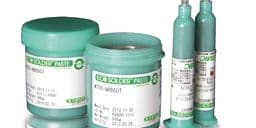
Moisture control for semiconductor materials
Adhesives, solder paste and packaged components are all sensitive to temperature and humidity. Storing them under the right conditions from the moment they are received helps semiconductor plants avoid popcorn failures during reflow, voids in solder joints and viscosity drift that disrupts the adhesive dispensing process.
Many defects detected at the final stages actually originate in the warehouse. Below are the control principles AMS applies in its cold chain and recommends to customers.
What defects does moisture cause in semiconductor packaging
Epoxy molding compounds and organic substrates absorb moisture from the air. When passing through a reflow oven at 245–260°C, this moisture vaporizes suddenly, generating enough pressure to cause delamination or crack the component body, a defect known as popcorning. For underfill and die attach adhesives, absorbed moisture creates bubbles during curing, reducing adhesion and thermal conductivity.
Storage conditions for each material group
Solder paste
Solder paste is typically stored at 0–10°C. Before use, it should be allowed to thaw naturally for 4–8 hours in a sealed container to prevent water vapor from condensing on the paste surface. Do not open the lid while the paste is still cold and do not warm it in a drying oven.
One-part heat-cure adhesives
Many one-part epoxy grades must be stored at -40°C or -20°C. Once thawed, their pot life on the machine is only a few days to a few weeks, so the thaw time must be clearly labeled.
Moisture-sensitive components
Components are classified by MSL according to the J-STD-033 standard. After the moisture barrier bag is opened, they may only be exposed to the environment for the permitted floor life; once exceeded, they must be rebaked.
Recommended control procedure
- Check the shipping box temperature and temperature indicators on receipt, and reject any lot showing signs of thawing.
- Place materials into cold storage on a first-in, first-out basis and according to expiration date.
- Record the thaw time, the time loaded on the machine and the expiration time on the label.
- Keep the production area at 22–26°C and 40–60% relative humidity.
- Store components from opened bags in dry cabinets below 5% RH.
A properly labeled refrigerator and a rigorously kept thaw log often deliver results faster than changing materials. Most of the voiding issues we have investigated were linked to rushed thawing.
Application Engineer, AMS Vietnam
In addition, it is good practice to periodically compare refrigerator temperature logs with defects arising on the line. When voiding or delamination rates spike, this data helps quickly pinpoint whether the cause lies in the material, the warehouse or the machine settings.
AMS ships temperature-sensitive materials in temperature-logged cold boxes to industrial parks in Bac Ninh, Bac Giang and Hai Phong. For advice on storage conditions for each adhesive grade, please contact AMS Vietnam.