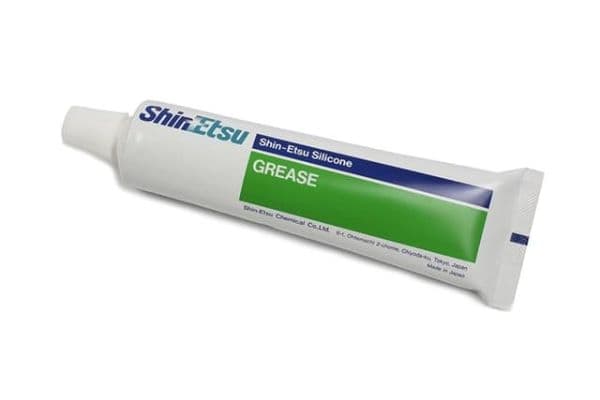
Thermal materials for solar inverters
Thermal pads and thermal grease are placed between IGBT modules and aluminum heat sinks in solar inverters, helping power components operate reliably even when the equipment sits under intense sun on a rooftop.
The inverter is the component most prone to failure in a solar power system. Most failures are heat related: when the IGBT junction temperature rises by 10 °C, the expected service life of the component can be cut nearly in half. A thermal interface layer only a few hundred micrometers thick plays a very large role.
The heat path in an inverter
Heat generated in the IGBT chip passes through the module's copper baseplate, through the thermal interface material, into the aluminum heat sink and out to the air. In this chain, the interface layer is often the point with the highest thermal resistance if the wrong material is chosen or it is applied unevenly.
Comparing thermal interface material types
| Material type | Thermal conductivity | Advantages | Limitations |
|---|---|---|---|
| Thermal grease | 1 – 5 W/m·K | Very thin bond line, low thermal resistance | Can be pumped out by thermal cycling |
| Phase change material | 3 – 8 W/m·K | Clean to install, liquefies at around 50 °C | Higher cost than grease |
| Silicone gap pad | 1.5 – 6 W/m·K | Easy to install, electrically insulating | Thicker, higher thermal resistance |
| Ceramic-filled insulating pad | 1 – 3.5 W/m·K | High dielectric strength | Requires sufficient clamping force |
Pump-out and how to prevent it
Under daily hot and cold cycles, the IGBT module baseplate flexes slightly, gradually pushing the thermal grease toward the edges. After a few years, the center of the module runs dry and the temperature spikes. Phase change materials and high-viscosity greases resist this phenomenon better.
- Apply grease by stencil printing to control thickness uniformly.
- Tighten bolts in a cross pattern to the recommended torque.
- Check coverage by disassembling a sample at the start of each shift.
Selection by power range
Residential inverters of a few kW can use gap pads to simplify assembly. String inverters and central inverters of hundreds of kW should use grease or phase change material to optimize thermal resistance.
To evaluate performance, engineers can attach temperature sensors to the module baseplate and measure at rated power in a 45 °C thermal chamber. Comparing results between materials on the same inverter sample reveals the real-world differences far more accurately than simply reading the thermal conductivity on a data sheet.
Contact AMS Vietnam to request samples of Shin-Etsu, Bergquist and Dow thermal materials for solar inverters.